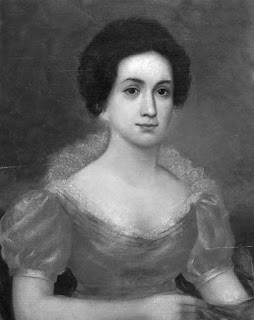
Don't forget to double click on pictures to enlarge
Showing posts with label Our First Ladies. Show all posts

Wednesday, April 27, 2022

Our First Ladies #13

                                                 Margaret Mackall  Smith Taylor

  
                                                            First Lady of the United States

                                                                             in role

                                                              March 4, 1849 - July 9, 1850


Born in Calver County, Maryland on September 21, 1788, the daughter of Walter Smith, a prosperous Maryland planter and veteran officer of the American Revolution, and the former Ann Mackall, “Peggy” was raised amid refinement and wealth.

While visiting her sister in Kentucky in 1809, she was introduced to Lieutenant Zachary Taylor, who was home on leave.

Lt. Taylor, aged 25, married Peggy Smith, aged 21, on June 21, 1810, at the home of the bride’s sister, Mrs. Mary Chew near Louisville, Kentucky. She followed him from fort to fort as his career advanced except for while he was serving in the Mexican American War; She lived at their Cypress Grove Plantation in Jefferson County, Mississippi.

With the rise in Zachary Taylor’s political career, his wife Peggy Taylor literally prayed for his defeat, for she dreaded the personal consequences of his becoming the president. By the time she became the First Lady in 1849, the hardships of following her husband from fort-to-fort and enduring several childbirths over the 39 year period had taken their toll. Two small girls died in 1820 of what Taylor called “a violent bilious fever,” which left Peggy’s health impaired; three girls and a boy grew up.

A semi-invalid, she remained in seclusion on the second floor of the White House, leaving the duties of official hostess to her daughter, Mary Elizabeth “Betty” Bliss.

After participating in ceremonies at the Washington Monument on a blistering July 4, 1850, President Taylor fell ill and within five days he was dead. Margaret Taylor’s health deteriorated rapidly after his sudden death. She died two years later August 14, 1852, in Pascagoula, Mississippi. She was buried next to her husband near Louisville, Kentucky.


Monday, March 7, 2022

First lady #12


1803-1891

As the eldest daughter of Captain Joel and Elizabeth Childress she was use to a life of silks and satin growing up on a plantation near Murfreesboro, Tennessee. She also was one the few women of the 19th century to be afforded an education of higher learning and it made her especially fitted to assist a man with a political career.

James K. Polk was laying the foundation for that career when he met her. He had begun his first years’ service in the Tennessee legislature when they were married on New Year’s Day, 1824; he was 28, she 20.

At a time when motherhood gave a woman her only acknowledged career, Sarah Polk had to resign herself to childlessness, but she accompanied her husband to Washington whenever she could, and they soon won a place in its most select social circles. Privately she helped him with his speeches, copying his correspondence and giving him advice. Not surprisingly when he returned to Washington as President in 1845, she stepped to her high position with ease and evident pleasure. She appeared at the inaugural ball, but as a devout Presbyterian, she did not dance.


Only three months after retirement in 1849 to their fine new home “Polk Place” in Nashville, he died, worn out by the years of public service. Clad always in black, Sarah Polk lived on in the home for 42 years, guarding the memory of her husband and accepting honors paid to her as honors due to him. The house because a place of pilgrimage. She lived to be 88 years old and is buried next to her husband. 


Monday, January 24, 2022

Our First Ladies # 11


                                                           Julia Gardiner Tyler 1820-1889


Julia Gardiner Tyler was born in 1820 to Juliana and David Gardiner, a landowner, and New York State Senator. (1824 to 1828). She was raised in the town of East Hampton and educated at the Chegary Institute in New York. In 1839, she shocked polite society by appearing, posed with an unidentified man, and identified as "The Rose of Long Island", in a newspaper advertisement for a middle-class department store. Her family took her to Europe to avoid further publicity and allow her notoriety to subside, but she was indeed a beauty.

On January 20, 1842, the 21-year-old Julia was introduced to President John Tyler at a White House reception. After the death of his first wife, Letitia Christian Tyler, on September 10, 1842, Tyler made it clear that he wished to get involved with Julia. Initially, the high-spirited and independent-minded northern beauty felt little attraction to the grave, reserved Virginia gentleman, who was thirty years her senior. He first proposed to her on February 22, 1843, when she was 22, at a White House Masquerade Ball. She refused that and later proposals he made. The increased time spent together prompted public speculation about their relationship.

Julia, her sister Margaret, and her father joined a Presidential excursion on the new steam frigate Princeton. During this excursion, her father, David Gardiner, along with others, lost his life in the explosion of a huge naval gun called the Peacemaker. Julia was devastated by the death of her adored father. She spoke often in later years of how the President's quiet strength sustained her during this difficult time. Tyler comforted Julia in her grief and won her consent to a secret engagement, proposing in 1844 at the George Washington Ball.

After a wedding trip to Philadelphia, a White House reception, and a stay at Sherwood Forest, an estate the president had recently acquired for his retirement, the newlyweds returned to Washington D.C.. Although her husband was often visibly fatigued, his youthful wife thoroughly enjoyed the duties of First Lady.

President Tyler was 54 years old, while Julia was just 24. Tyler's oldest daughter, Mary, was 5 years older than her father's new wife. The marriage made Julia the first (First Lady) to marry a President who was already in office at the time of the wedding.

It was awkward for the eldest Tyler daughter, Mary, to adjust to a new stepmother five years younger than herself. One daughter, Letitia, never made peace with her stepmother.

The anthem "Hail to the Chief" had been played at a number of events associated with the arrival or presence of the President of the United States before Julia Tyler became First Lady, but she ordered its regular use to announce the arrival of the President. It became established practice when her successor, Sarah Polk did likewise. It is still practiced today.

The first lady was known as a wonderful hostess and the President was delighted with all the compliments she received. When the President’s term was finished, they retired to The Sherwood Forest Plantation.

 All though a northerner by birth, Mrs. Tyler soon grew accustomed to the leisurely routines of daily life as the wife of a wealthy plantation owner, and between 1846 and 1860, Julia and John had seven children together.

Julia wrote a defense of slavery titled "The Women of England vs. the Women of America", in response to the "Stafford House Address" petition against slavery which the Duchess of Sutherland had helped to organize.

In response to Julia Tyler's essay, Harriet Jacobs, a former slave and later abolitionist writer, authored her first published work, a letter to the New York Tribune in 1853.

After her husband's death in 1862, lost her 60 slaves and 1,100 acres of land due to military events. Julia moved north to Staten Island with several of her children and family relations were so strained that her brother David moved out of his mother's house, where Julia had settled.

Her home there was almost burned down by enraged Union veterans when it was discovered she was flying a Confederate flag on the property. She resided at the Gardiner-Tyler House from 1868-74.

In 1865, her brother David sued to prevent her from inheriting the bulk of their mother's estate valued at $180,000, charging that Julia Tyler had exerted "undue influences" on their mother to execute a will despite her "mental incapacity". The court supported his claim on August 25 and refused to accept the will. After two appeals, David Gardiner won the case in 1867. David then asked the courts to partition the estate as if no will existed. Julia asked for a jury trial on the issue, and the jury declined to consider the contested will as an argument in her favor. The New York Times thought Julia was treated unfairly and that the dispute could be traced to "the political antagonisms of the rebellion, which have divide many a household besides that of Mrs. Gardiner". She died in 1889 and is buried next to her husband in Virginia.

Tuesday, November 9, 2021

Our first ladies #10


Letitia Tyler (née Christian; November 12, 1790 – September 10, 1842) was the first wife of President John Tyler and first lady of the United States from 1841 to 1842.[1]

She married Tyler, then a law student, in 1808 at Cedar Grove, her family home. Their twenty-nine year marriage appears to have been a happy one, although Letitia avoided the limelight during her husband's political rise, remaining in Virginia during most of his time in congress. Her later life was dogged by ill-health; a paralytic stroke suffered in 1839 left her an invalid. As first lady, she remained in the White House living quarters, leaving them only to attend her daughter Elizabeth's wedding in January 1842. She suffered another stroke in September 1842 and died, becoming the first First Lady to while serving in her role.

Together, John and Letitia Tyler had four daughters and three sons who lived to maturity.


Tyler appears on a 28p (£0.28) commemorative postage stamp from the Isle of Man Post Office, issued May 23, 2006, as part of a series honoring Manx-Americans.[10] She also appears on a one-half ounce gold coin and a bronze medal issued by the United States Mint on July 2, 2009.


Monday, September 27, 2021

First Lady #9


                                                   Anna Tuthill Symmes Harrison


Anna Tuthill Harrison was the wife of President William Henry Harrison and grandmother of President Benjamin Harrison, and was nominally first lady of the United States during her husband's one-month term in 1841, though she never entered the White House due to the fact that he died exactly one month after the inauguration. The couple had been married 45 years when he was elected President and she had borne him five children. At the time she was too ill to travel when her husband set out from Ohio in 1841 for his inauguration, it was a long trip and a difficult one even by steamboat and railroad, with February weather uncertain at best and she at 65 was well acquainted with the rigors of frontier journeys as he was a decorated soldier. So, it was decided that his daughter-in-law would accompany him and serve until May when she planned to make the trip. She was packing when she received word of his death and never went. Accepting grief with admirable dignity, she stayed at her home in North Bend until the house burned in 1858; she lived nearby with her last surviving child, John Scott Harrison, until she died in February 1864 at the age of 88.

Friday, August 27, 2021

First Lady #8

 Hanna Hoes Van Buren 1783-1819


His childhood sweetheart and cousin once removed, Hannah Hoes Van Buren was the wife of the eighth President, Martin Van Buren. She died of tuberculosis before he was elected, leaving him one of the few Presidents to remain unmarried in office. Not much is known of her but in the 12 years they were married she bore five children, one died.  

Tuesday, June 29, 2021

First Lady #7


                                            Rachel Donelson Robards Jackson

If this does not grab your attention, I don’t know what would.

Wearing the white dress she had purchased for her husband’s inaugural ceremonies in March 1829, Rachel Donelson Jackson was buried in the garden at The Hermitage, her home near Nashville, Tennessee, on Christmas Eve in 1828.


Rachel Donelson was a child of the frontier. Born in Virginia, she journeyed to the Tennessee wilderness with her parents when only 12. At 17, while living in Kentucky, she married Lewis Robards, of a prominent Mercer County family. His unreasoning jealousy made it impossible for her to live with him; in 1790 they separated, and she heard that he was filing a petition for divorce. 

Andrew Jackson married her in 1791; and after two happy years they learned to their dismay that Robards had not obtained a divorce, only permission  to file for one. Now he brought suit on grounds of adultery. After the divorce was granted the Jackson quietly remarried in 1794 amid the scandal. 

The Jacksons never had children of their own, but gladly opened their home to the children of Rachel's many relatives. In 1809 they adopted a nephew and named him Andres Jackson Jr. They also reared other nephews; one, Andrew Jackson Donelson, who eventually married his cousin Emily, of of Rachel's favorite nieces and it was she who fulfilled the duties of  the first lady after her death in 1828. 


Saturday, May 29, 2021

First Lady #6


                                                         Louisa Katherine Adams

Louisa Adams was born on February 12, 1775, in London., The illegitimate daughter of Joshua Johnson, an American merchant from Maryland.

She met John Quincy Adams at her father's house in Cooper's Row, near Tower Hill, London. Her father had been appointed as United States consul general in 1790, and Adams first visited him in November 1795. Adams at first showed interest in her older sister but soon settled on Louisa. Adams, aged 30, married Louisa, aged 22, on July 26, 1797. John Quincy Adams’s father (John Adams) was then the current President of the United States.

 Louisa was pregnant fourteen times, miscared nine times and one child was stillborn. Three sons and one daughter survived. Her husband served in many different areas including in Russia before being elected President in 1825. He only served one term and she was known as a great hostess during that time.


The First Spouse Gold Coins Program was authorized by the Presidential $1 Coin Act of 2005 (Public Law 109-145).


Her husband died at the Capitol in 1848. She remained in Washington until her death of a heart attack on May 15, 1852, at the age of 77. The day of her funeral was the first time both houses of the United States Congress adjourned in mourning for any woman. 

Friday, March 19, 2021

First Lady #5


Elizabeth Kortright married James Monroe in February 1786, when the bride was not yet 18.

Early in their marriage the family increased by two daughter and a only son who died in infancy.

Elizabeth was an accomplished hostess, when her husband took the Presidential oath in 1817 but through much of the administration she was in poor health and curtailed her activities.  Later it was determined that she suffered from epilepsy.   

With such a fast difference from the former first lady Dolley Madison, she was considered an elitist and aloof by many and her wish to remain private led to many criticisms.  Not to be deterred she and her daughter Eliza changed White House customs to create the formal atmosphere of European courts. Even the white House wedding of her daughter Maria was private, in ‘the New York style” rather than the expansive Virginia social style made popular by her predecessor.

Elizabeth was too ill to leave the White House when her husband’s second term ended in March 1725; it would be another three weeks before the Monroes were finally able to retire to their estate in Oak Hill, Virginia.  Not long afterward, Elizabeth suffered a seizure and collapsed near an open fireplace, leading to severe burns. She lived for another three years, often in pain, until her death on September 23, 1830. Noting that he wouldn’t survive long without her, the grief-stricken Monroe passed away less that a year later.

Thursday, February 4, 2021

Our first Ladies #4


 Dolley Payne was born on May 20, 1768, in the Quaker 

In January 1790, Dolley Payne married John Todd, a Quaker lawyer in Philadelphia. They quickly had two sons, John Payne (called Payne) and William Temple (born July 4, 1793]). After Mary Payne left Philadelphia in 1793, Dolley's sister Anna Payne moved in with them to help with the children.

In August 1793, a yellow fever epidemic broke out in Philadelphia, killing 5,019 people in four months. Dolley was hit particularly hard, losing her husband, son William, mother-in-law, and father-in-law.

While undergoing the loss of much of her family, she also had to take care of her surviving son without financial support. While her husband had left her money in his will, the executor, her brother-in-law, withheld the funds and she had to sue him for what she was owed.

In May 1794, Burr made the formal introduction between the young widow and Madison, who at 43 was a longstanding bachelor 17 years her senior. A brisk courtship followed and, by August, Dolley accepted his marriage proposal.

When Thomas Jefferson was elected as the third president of the United States in 1800, he asked Madison to serve as his Secretary of State. Madison accepted and moved Dolley, her son Payne, her sister Anna, and their domestic slaves to Washington on F Street. They took a large house, as Dolley believed that entertaining would be important in the new capital

Dolley worked with the architect Benjamin Henry Latrobe to furnish the White House, the first official residence built for the president of the United States. She sometimes served as widower Jefferson's hostess for official ceremonial functions

In the approach to the 1808 presidential election, with Thomas Jefferson ready to retire, the Democratic-Republican caucus nominated James Madison to succeed him. He was elected President, serving two terms from 1809 to 1817, and Dolley became the official White House hostess. Thel first “first” lady to live in the White House. Dolley helped to define the official functions, decorated the Executive Mansion, and welcomed visitors in her drawing room. She was renowned for her social graces and hospitality and contributed to her husband's popularity as president. She was the only First Lady given an honorary seat on the floor of Congress, and the first American to respond to a telegraph message. In 1812, James was re-elected. This was the year that the War of 1812 began with Great Britain

After the United States declared war in 1812 and attempted to invade Canada in 1813, a British force attacked Washington in 1814. As it approached and the White House staff hurriedly prepared to flee, Dolley ordered the Stuart painting, a copy of the famous George Washington portrait to be saved, as she wrote in a letter to her sister at 3 o'clock in the afternoon of August 23:

Our kind friend Mr. Carroll has come to hasten my departure, and in a very bad humor with me, because I insist on waiting until the large picture of General Washington is secured, and it requires to be unscrewed from the wall. The process was found too tedious for these perilous moments; I have ordered the frame to be broken and the canvas taken out ... It is done, and the precious portrait placed in the hands of two gentlemen from New York for safe keeping. On handing the canvas to the gentlemen in question, Messrs. Barker and Depeyster, Mr. Sioussat cautioned them against rolling it up, saying that it would destroy the portrait. He was moved to this because Mr. Barker started to roll it up for greater convenience for carrying.

Popular accounts during and after the war years tended to portray Dolley as the one who removed the painting, and she became a national heroine. Early twentieth-century historians noted that Jean Pierre Sioussat had directed the servants, many of whom were slaves, in the crisis, and that house slaves were the ones who actually preserved the painting.

Dolley Madison hurried away in her waiting carriage, along with other families fleeing the city. They went to Georgetown and the next day they crossed over the Potomac into Virginia. When the danger receded after the British left Washington a few days later, she returned to the capital to meet her husband. However, the rampant pillaging and systematic destruction had desolated much of the new city. As Congress began discussions over the construction of a new capital, Dolley and James moved into The Octagon House.

On April 6, 1817, a month after his retirement from the presidency, Dolley and James Madison returned to the Montpelier plantation in Orange County, Virginia.

In 1830, Dolley's son Payne Todd, who had never found a career, went to debtors' prison in Philadelphia and the Madisons sold land in Kentucky and mortgaged half of the Montpelier plantation to pay his debts.

James died at Montpelier on June 28, 1836.

Dolley remained at Montpelier for a year. Her niece Anna Payne moved in with her, and Todd came for a lengthy stay. During this time, Dolley organized and copied her husband's papers. Congress authorized $55,000 as payment for editing and publishing seven volumes of the Madison papers, including his unique notes on the 1787 convention.

In the fall of 1837, Dolley returned to Washington, charging Todd with the care of the plantation. She and her sister Anna moved into a house, bought by Anna and her husband Richard Cutts, on Lafayette Square. Madison took Paul Jennings with her as a butler, and he was forced to leave his family in Virginia.

In Washington 1837–1849


While Dolley Madison was living in Washington, Payne Todd was unable to manage the plantation, due to alcoholism and related illness. She tried to raise money by selling the rest of the president's papers. She agreed to sell Jennings to Daniel Webster, who allowed him to gain his freedom by paying him through work.

Unable to find a buyer for the papers, she sold Montpelier, its remaining slaves, and the furnishings to pay off outstanding debts.

Paul Jennings, the former slave of the Madisons, later recalled in his memoir,

In the last days of her life, before Congress purchased her husband's papers, she was in a state of absolute poverty, and I think sometimes suffered for the necessaries of life. While I was a servant to Mr. Webster, he often sent me to her with a market-basket full of provisions, and told me whenever I saw anything in the house that I thought she was in need of, to take it to her. I often did this, and occasionally gave her small sums from my own pocket, though I had years before bought my freedom of her.

In 1848, Congress agreed to buy the rest of James Madison's papers for the sum of $22,000 or $25,000.

In 1842, Dolley Madison joined St. John's Episcopal Church, Lafayette Square in Washington, D.C. This church was attended by other members of the Madison and Payne families.

On February 28, 1844, Madison was with President John Tyler while aboard the USS Princeton when a "Peacemaker" cannon exploded in the process of being fired. While Secretaries of State and Navy Abel P. Upshur and Thomas Walker Gilmer, Tyler's future father-in-law David Gardiner and three others were killed, President Tyler and Dolley Madison escaped unharmed.

She died at her home in Washington in 1849, at the age of 81. She was first buried in the Congressional Cemetery, Washington, D.C., but later was re-interred at Montpelier next to her husband.
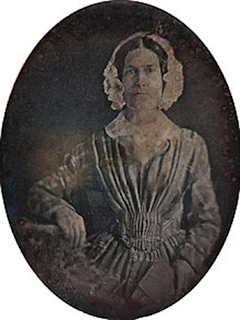
Saturday, November 28, 2020

Our first Lady 3

 Martha Wayles Skelton Jefferson

This was such a odd story as Martha's mother died just 3 days after her birth and was raised by two stepmothers one of which was a mixed black slave whom her father married.

She herself married at 18 years old but her husband died just 1 year and 10 months after their wedding. She gave birth to one son and inherited the Forest Plantation.

At 23 years old she met and married Thomas Jefferson who was at the time a lawyer and a member of the House of Burgesses for Albemarle County at the forest plantation but moved to what would come to be known as Monticello.

The following is from this web site http://www.firstladies.org/biographies/firstladies.aspx?biography=3

Martha Jefferson's health began to rapidly deteriorate, the result likely of having given birth to seven children in less than fourteen years. The British invasion of Virginia under Lord Cornwallis in 1781 forced her to flee Monticello for their more isolated Bedford County home " Poplar Forest , and it weakened her 16-month old daughter Lucy, who died weeks later. Jefferson shortly thereafter resigned his position as governor and promised his wife that he would refuse any more political posts. Thus Jefferson turned down an important diplomatic mission to Europe. Her final pregnancy proved more burdensome than her marital separations; she died four months after childbirth. 

Martha Jefferson, however, was also to leave an unwitting legacy to her husband on two accounts. With the death of her father in 1772, Martha Jefferson inherited substantial property, including approximately 11,000 acres of land ( retaining 5,000 ) and slaves, including her half-siblings. By law, his wife's property became his own upon marriage, and so Jefferson came into ownership of his slave half sisters-in-law Thenia, Critta and Sally and brothers-in-law Robert and James Hemings. 

Since they were one-quarter African-American and three-quarters white and also related by blood to Martha Jefferson, the five Wayles-Hemings children occupied a unique role within the Jefferson family. None were called " slaves, " but always referred to as " servants. " They worked in the most personal and private servantile roles at Monticello. In 1790, Robert Hemings bought his freedom and joined his wife and daughter in Richmond, where they worked for a doctor. James Hemings was particularly close to Jefferson, working as his personal aide or " body servant, " traveling with him to Philadelphia during the Second Continental Congress and later to Europe. While in Paris, James Hemings studied the culinary French arts; upon returning to Virginia, he trained his younger brother Peter to oversee the detailed French cooking that Jefferson now insisted on serving. Jefferson gave James Hemings his freedom. Critta Hemings helped to raise her half-nieces Patsy and Polly. Thenia Hemings was the only one of Martha Jefferson's half-siblings who was sold as a slave - to family friend and future President James Monroe.

Thomas Jefferson never married again and while President the wife of his highest-ranking Cabinet member, Dolley Madison served as the public hostess.


There were no known pictures of Martha Jefferson and only a painted portrait done 183 years after her death based on descriptions of her.


Sunday, November 8, 2020

Our first lady 2 (Please note I had originally posted that Lucy Ware Webb Hayes was the 2nd first lady but she was our 20th!!)

 ABIGAIL SMITH ADAMS


When just 15 years old Abigail met John Adams and although her father approved of the match, her mother was appalled that her daughter would marry a country lawyer whose manner still reeked of the farm, but eventually she gave in. The couple married on October 25, 1764, in the Smiths' home in Weymouth. Smith, Abigail's father, presided over the marriage of John Adams and his daughter. After the reception, the couple mounted a single horse and rode off to their new home, the small cottage and farm John had inherited from his father in Braintree, Massachusetts.[3] Later they moved to Boston, where his law practice expanded. The couple welcomed their first child nine months into their marriage.

In 12 years, she gave birth to six children:


Yes she was the mother of John Quincy Adams our 6th president.

John Adams was inaugurated as the second President of the United States on March 4, 1797, in Philadelphia. Abigail was not present at her husband's inauguration as she was tending to his dying mother.] When John was elected President of the United States, Abigail continued a formal pattern of entertaining. She held a large dinner each week, made frequent public appearances, and provided for entertainment for the city of Philadelphia each Fourth of July.

She took an active role in politics and policy, unlike the quiet presence of Martha Washington. She was so politically active, her political opponents came to refer to her as "Mrs. President". As John's confidant, Abigail was often well informed on issues facing her husband's administration, at times including details of current events not yet known to the public in letters to her sister Mary and her son John Quincy. Some people used Abigail to contact the president. At times Abigail planted favorable stories about her husband in the press. Abigail remained a staunch supporter of her husband's political career, supporting his policies, such as passing the Alien and Sedition Acts.

With the relocation of the capital to Washington, D.C., in 1800, she became the first First Lady to reside at the White House, or President's House as it was then known. Adams moved into the White House in November 1800, living there for only the last four months of her husband's term.

Although she followed her son's political career earnestly she did not live to see him become the 6th President. She died in her home on October 28, 1818, of typhoid fever. She is buried beside her husband and near their son John Quincy in a crypt located in the United First Parish Church (also known as the "Church of the Presidents") in Quincy, Massachusetts. She was 73 years old, exactly two weeks shy of her 74th birthday. Her last words were, "Do not grieve, my friend, my dearest friend. I am ready to go. And John, it will not be long."


Tuesday, October 20, 2020

Our First Lady #2

 Lucy first met Rutherford B. Hayes at Ohio Wesleyan University. At the time, Lucy was fourteen years old and Rutherford was twenty-three a 15 year age difference. Rutherford's mother was hopeful that the two would find a connection, but at this point Rutherford considered Lucy "not quite old enough to fall in love with."

Rutherford and Lucy Hayes on their wedding day: December 30, 1852.

In 1850, Rutherford's older sister Fanny Platt encouraged him to visit with Lucy again. That summer Lucy was 19, and she and Rutherford were members of the same wedding party. Rutherford was so taken with Lucy that he gave her the prize (a gold ring) that he had found in the wedding cake.

In 1851, Rutherford wrote in his diary, "I guess I am a great deal in love with L(ucy). ... Her low sweet voice ... her soft rich eyes." Rutherford also praised her intelligence and character, "She sees at a glance what others study upon, but will not, perhaps study what she is unable to see at a flash. She is a genuine woman, right from instinct and impulse rather than judgment and reflection."

After the couple became engaged, Lucy returned the wedding cake ring to Rutherford. He wore that ring for the rest of his life.

It was a small wedding that took place in Lucy's mothers home with only a small group of people and there was nothing said about the dress she was wearing but some interesting tidbits is that Lucy was the first Presidential wife that was called "the first Lady" Lucy Hayes was the first wife of a President to be widely referred to as the First Lady by the press, when Mary Clement Ammes referred to the "First Lady" in a newspaper column about the inauguration. Advances in printing technology meant that a wide audience saw sketches of the new First Lady from the 1877 inauguration.

At this time it was not the custom for a president's wife to have a staff of social assistants and, unlike some previous First Ladies, Lucy had no adult daughters to help shoulder the workload. Lucy depended on nieces, cousins, and daughters of friends to help with social events, and these young ladies also helped enliven the Hayes White house. Also unusual for the time, she had a college degree and bore 8 Children. 


 Her portrait  

The most significant change made to the White House during Hayes' term were the installation of bathrooms with running water and the addition of a crude wall telephone. Lucy was the first First Lady to use a typewriter, a telephone, and a phonograph while in office, and was also the first to enjoy a permanent system of running water in the White House.

Lucy preferred to enlarge the greenhouse conservatories rather than to undertake extensive redecoration of the White House. The billiard-room, which connected the house with the conservatories, was converted into an attractive greenhouse and the billiard table consigned to the basement. Shuttered windows in the State Dining Room could be opened for dinner guests to look into the conservatories. Some Americans considered the billiard table as either a gambling device or a rich man's toy, and the Hayes were glad to get it out of sight.


Lucy preceded her husband in death in 1889 at 57 years.